

Industry Talk - POV
Why "Made by a Human" Is Turning Into a Price Tag
by Richard El Hashem
July 28, 2026
Let
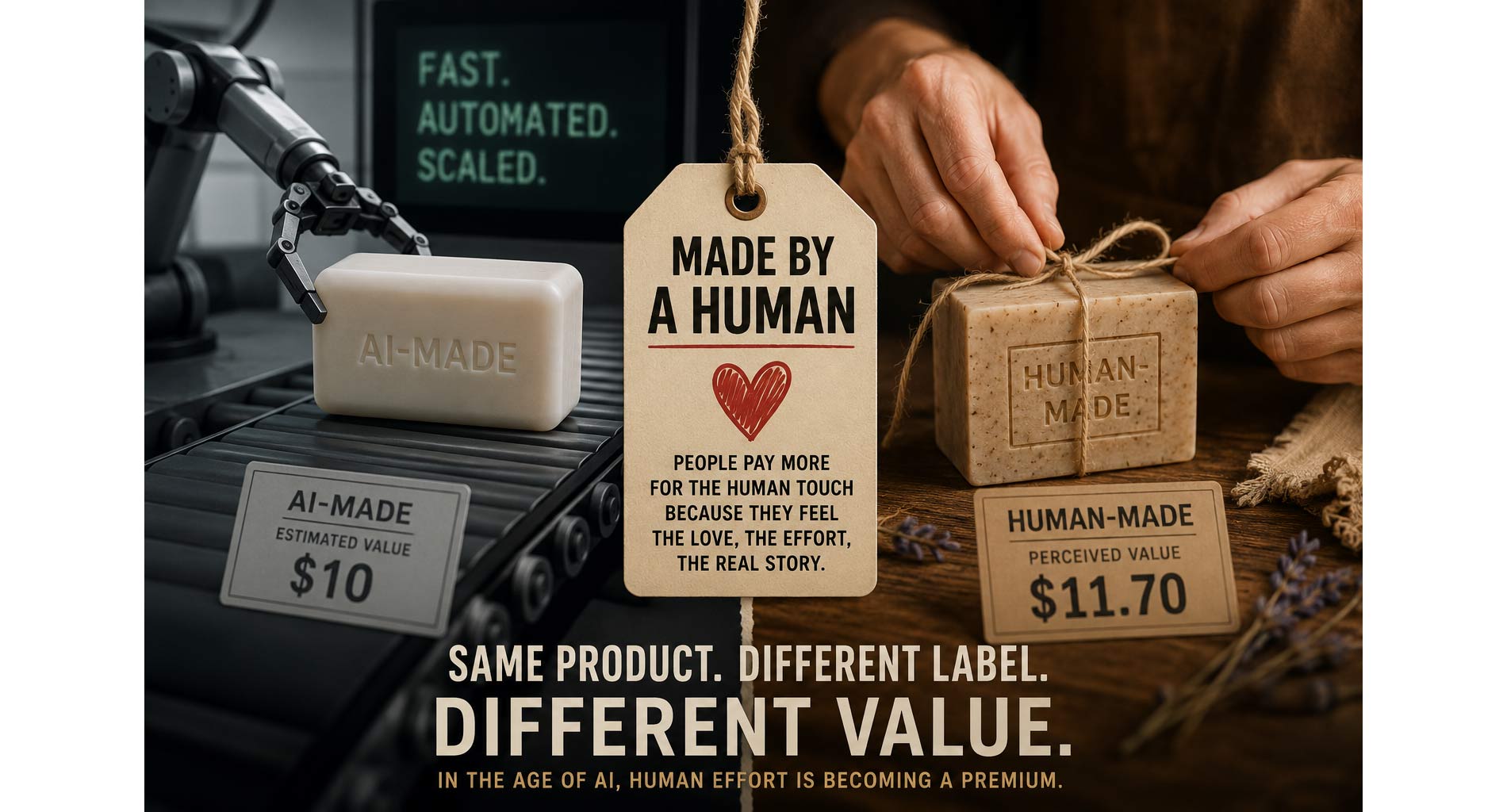
me tell you about a bar of soap.
Back
in 2015, some researchers in Vienna and Rotterdam ran a little experiment. They
took the exact same bar of soap and put it in front of shoppers. Half the time
it was labeled "handmade". Half the time it said "machine-made",
Nothing else changed. Same soap, same smell, same price tag to start.

People were willing to pay 17% more for the "handmade" one. Same soap. Just a different word on the label.
Why? When the researchers asked people, it came down to one simple feeling: handmade things feel like they have love in them.
The study was called "The Handmade Effect: What's Love Got to Do with It?", written by Christoph Fuchs, Martin Schreier, and Stijn van Osselaer, and published in the Journal of Marketing back in 2015, years before ChatGPT was even a thing. But I keep thinking about it, because now there's a new question worth asking: does the same trick work when the "machine" isn't a factory line, but an AI that can write, paint, and design in seconds?
Turns out, yes. And in some cases, people punish the AI-made version even harder than they used to reward the handmade one.
This isn't just a fun fact anymore. It's turning into real business strategy.
People Will Actually Pay More for "Human"
Here's what the research keeps finding, over and over, in different countries and different fields.
- We pay for the struggle, not just the result. In a 2026 study that surveyed 70 people on how they reacted to human- versus AI-made creative work, almost 73% said they'd pay more for something made by a human than something made by AI; even when both looked equally good. Researchers call this the "effort heuristic." Basically, we're not just buying the finished thing. We're buying the imagined sweat behind it. And here's the interesting part: showing people the actual process - a video, a messy draft, a timestamp - convinced them more than any hand-crafted "imperfection" ever did. People don't want fake flaws. They want proof.
- AI art looks just as good. People just won't pay for it. A group of five separate studies published in the Journal of Business Research found that people enjoy AI-made art just as much as human-made art, when you ask them to rate it blind. But they still pay way less for it. Not because they think AI has no "soul"; it's simpler than that. They just assume less work went into it. When you tell people a human was actually involved somewhere in the process - tweaking it, picking it, editing it - that gap shrinks fast. And interestingly, tipping worked better than a flat price for this kind of work. Tipping feels like rewarding a person. A price tag feels like buying a product.
- Slapping "AI-generated" on something is basically a discount sticker. A June 2026 study in Frontiers in Psychology took identical content and just changed the label. The moment it said "AI-generated," people assumed less effort went into it and offered to pay less; even though nothing else was different. A separate real-world test by market-research firm SegmentOS in July 2026 found the same thing on an actual app: same app, same description, but calling it "AI-powered" dropped what people were willing to pay from $13 to $10. That's a 25% hit, from one word. And 68% of people said flat out they'd pick the "human-made" version over an identical AI one, even at the same price.
- This isn't just about art and crafts anymore. A 2025 study in the Journal of Management Information Systems, based on 41 interviews plus a survey of 421 people, found the same pattern in digital news products and coined a name for it: the "algorithm discount." It shows up in apps, in news articles, in jewelry, in scarves; basically, anywhere people feel an emotional connection to what they're buying. The pattern is everywhere researchers look.
Put it all together, and it's not one weird lab result. It's the same thing showing up again and again, in totally different studies, using totally different methods. When people know AI was involved, they assume less effort went in; and that assumption hits their wallet.
Why This Happens
Three things keep coming up:
- It's about effort, not magic. I used to think people believed AI was missing some mystical "soul." But that's not really it. People are pricing in how much work they think went into something. And that's actually useful news for businesses; because unlike "soul," effort is something you can show people.
- AI has already burned some trust. Remember when CNET got caught publishing AI-written financial advice under a vague fake byline back in 2023? When they checked their own AI-assisted articles, more than half had errors; one article failed basic math about compound interest so badly they had to issue a correction. That kind of thing sticks in people's minds. It turned a vague fear ("AI makes stuff up") into a real, countable failure rate.
- Ignoring how people feel about this can cost you. In 2025, Duolingo's CEO announced the company was going "AI-first" and would replace human contractors with AI. The internet did not take it well. Duolingo lost over 400,000 TikTok followers in weeks and eventually deleted its social posts entirely. The mistake wasn't really using AI; plenty of companies do that fine. It was how they talked about it. They framed it as "this saves us money," never as "this makes things better for you." People heard that loud and clear, and they didn't like what they heard.
Companies Are Already Cashing In On This
This isn't just theory anymore. Real businesses are building around it.
The “Authors Guild” launched a "Human Authored" certification; a little seal you can put on a book, backed by an actual public database you can check. It costs $10 a title. You can use AI to help brainstorm or check spelling, but the actual writing has to be human. Over 3,000 authors have already certified around 5,000 books.
There's also "Not By AI," a badge founded by designer Allen Hsu right as ChatGPT first went viral, and it's since spread across tens of thousands of websites. It's more of an honor-system pledge than a real audit; the group behind it even admits there's no foolproof way to check if someone's telling the truth. That's earned it some side-eye from critics on places like Lobsters and Dice.camp, who point out that a badge with no verification behind it is more of a vibe than a certification.
There's a more technical alternative too: “Verify My Writing”, which runs manuscripts through a third-party AI-detection tool called Pangram and only hands out its "certified human written" seal above a 95-out-of-100 human-probability score.
The takeaway either way: the more verifiable the claim, the more it's actually worth.
What Actually Works
Based on everything above, here's what seems to matter:
- Show your work, don't just slap on a badge. A behind-the-scenes video beats a logo every time.
- Real verification beats an honor system. A checkable database is worth more than a pinky promise.
- Don't talk about AI like it's a cost-cutting move. Talk about what the person buying it gets out of it, not what you're saving.
- Try tipping instead of fixed pricing for creative or labor-heavy work; it frames the payment as rewarding a person, not buying a product.
- This matters most for things people feel something about; art, writing, jewelry, anything personal. It matters a lot less for, say, the software running quietly in the background.
But It's Not That Simple Either
I want to be fair here; the research isn't unanimous.
A 2025 study in Psychology & Marketing found that people were actually more willing to pay for AI-made things, especially when it was framed as "creation" rather than "generation," and when the human-AI collaboration was emphasized rather than hidden. Curiosity about the process can work in AI's favor too, in the right context.
And Duolingo, despite all that backlash? Revenue grew 41% that same quarter. So public outrage and business performance don't always move together, at least not right away.
A global consumer survey by Capgemini in January 2026 found 67% of people want AI content labeled. But oddly, adding a "human-made" label barely moves the needle compared to no label at all; because right now, most people still assume something's human-made unless told otherwise. That assumption is probably fading fast, though, as more and more of the internet gets written by AI. Which is exactly why I think this "human-made" premium is only going to grow from here.
Bottom Line
This isn't marketing folklore anymore. It's backed by real, repeated research; from that soap study a decade ago to the flood of new studies since AI went mainstream. And it's backed by real infrastructure now too: certification programs, verification databases, grassroots badges, and companies learning the hard way what happens when they get the messaging wrong.
The lesson isn't "don't use AI." It's that provable, visible human effort is now something people will pay for; the same way "organic" or "handmade" earned a premium before it. The businesses that figure out how to actually prove it, not just claim it, are the ones who'll get to charge for it.