

Industry Talk - POV
AI won't replace Marketers. It will destroy the ones who can't think in Systems
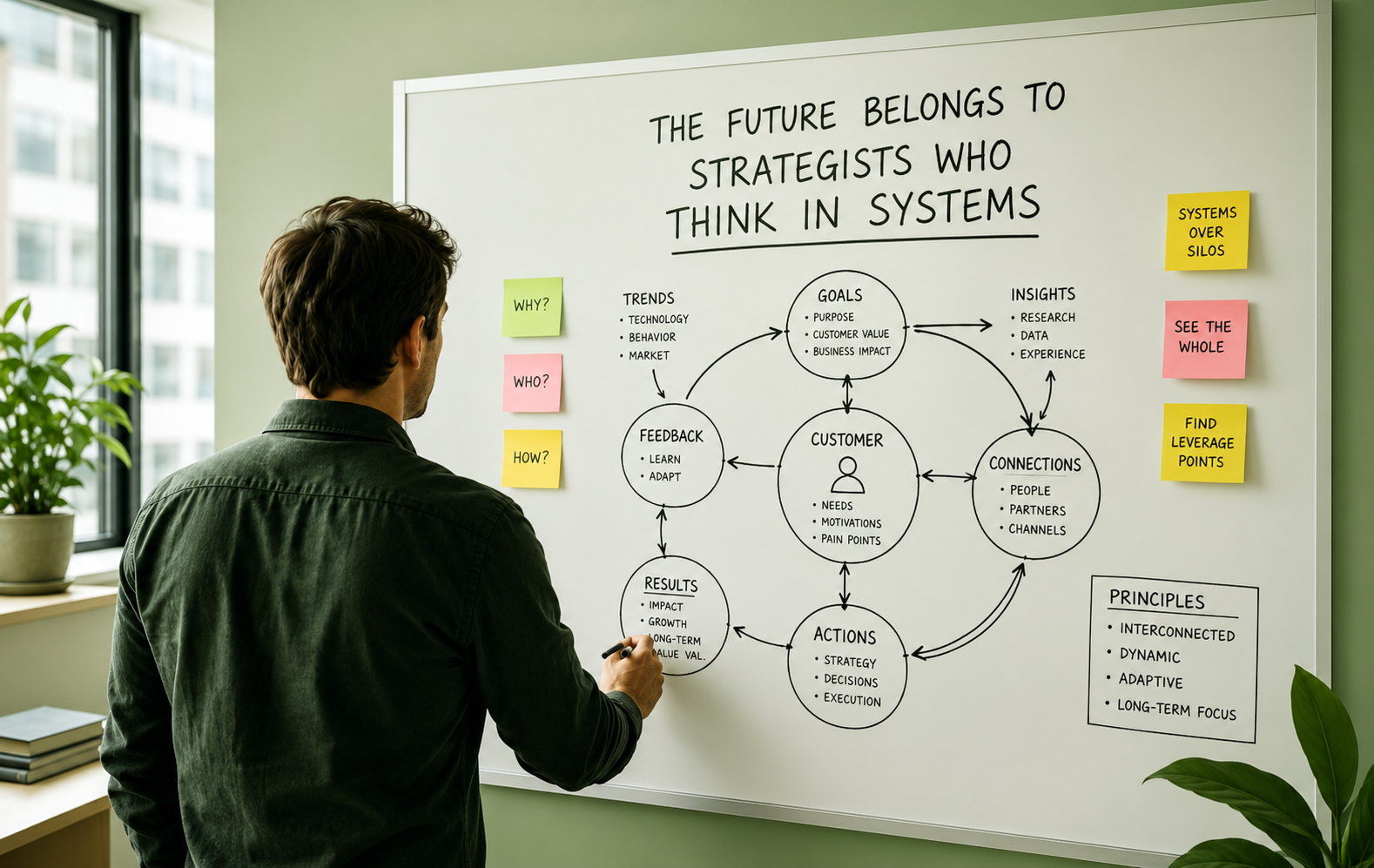
AI will not replace marketers — but it will challenge those who have relied on formulas instead of thinking. The next generation of strategists will be defined by their ability to see systems, not just create outputs. Richard El Hashem, Creative Strategic Advisor & Business Acceleration Director, elaborates.

I've lived through multiple "end of marketing" panics. The internet was supposed to kill traditional advertising. Social media was supposed to make brands obsolete. Programmatic was supposed to automate creativity. None of that happened. But this time, with AI, the anxiety feels different. Not because AI is smarter; though it is, in narrow ways. But because AI exposes a weakness that most marketers have spent decades hiding.
They don't understand systems.
The Template Trap
Let me be blunt: ChatGPT can write a decent brief. It can generate ad copy that's passable. It can even outline a strategy, if the strategy is generic. "Increase brand awareness through social media engagement." Sure. The AI can do that.
The marketers who will lose their jobs are the ones who copy-paste frameworks without understanding why they work. They're template-fillers. They've built careers on being able to produce outputs that look strategic but lack any original insight.
AI can replicate outputs. It cannot (yet) replicate the intuition of how a market breaks; where the hidden leverage points are, what unspoken fears customers have, which cultural nuances will make or break a campaign.
I've seen this in my own work. I can feed AI a year of customer support logs and ask for themes. It does a decent job. But when I ask, "what's the one emotional undercurrent that explains why people are angry, even though they say they're happy with the product?" the AI gives me a list of keywords. A human strategist, trained in behavioral science, spots the pattern: people are angry because they feel trapped, not because the product is bad. That insight changes everything. The AI can't get there.
What Becomes Valuable in an AI World
In a world where anyone can generate content, strategy, and analysis, the premium shifts to three things that AI cannot easily replicate.
First, proprietary behavioral data. The AI knows what's public. It doesn't know your customers' private frustrations, their unspoken desires, their hidden workarounds. The brands that invest in collecting their own behavioral data - through ethnography, diary studies, community panels - will have an unassailable advantage.
Second, cross-context pattern recognition. I've worked across hundreds of brands and 60+ industries. That breadth means I can see patterns that someone in a single category miss. An insight from healthcare might crack a problem in real estate. A loyalty mechanic from FMCG might transform a fintech retention program. AI is trained on siloed data. It lacks that cross-pollination.
Third, decision architecture design. Anyone can write a headline. Few people can design the entire system of choices that leads a customer to buy. That means understanding what information to present first, how to frame trade-offs, when to add friction and when to remove it. That's not copywriting. That's behavioral engineering. AI can optimize a single decision. It can't design the whole decision tree.

How to Become AI-Proof
So, what should you do, starting tomorrow, to ensure AI augments rather than replaces you?
First, start every question with "what is the system here?" Don't jump to tactics. Map the incentives, the bottlenecks, the feedback loops. Who benefits from the current way of doing things? What's the hidden constraint? Where's the leverage point? Systems thinking is the one skill AI cannot fake because systems are defined by their exceptions, not their rules.
Second, get your hands dirty with customer research. Not surveys. Not focus groups. Real, messy, unstructured conversations. Watch people use your product. Listen to their complaints. Notice what they don't say. AI can analyze transcripts. It cannot feel the frustration in someone's voice or see the micro-expression of confusion.
Third, use AI as a co-pilot for systems thinking, not a replacement for it. Feed it your hypotheses and ask it to simulate outcomes. "If we remove this step from checkout, what's the likely impact on returns?" The AI can model probabilities based on historical data. Then you apply your human judgment: "But our data doesn't capture the fact that this step also builds trust. So, we'll keep it."
The Future Belongs to Systems Thinkers
I'm not worried about AI replacing good strategists. I'm worried about mediocre strategists using AI to become faster at being mediocre. The gap between the best and the rest will widen dramatically.
The best strategists will use AI to handle drudgery, test scenarios, and scale their insights. They will spend more time on deep thinking, not less. They will be paid more, not less.
The template-fillers will be automated out of existence. Good riddance.
So, here's my challenge to you: the next time you ask AI to write something, pause. Ask yourself: could I have written that? If the answer is yes, you're not adding value. If the answer is no - because you have a proprietary insight, a unique perspective, a hard-won pattern - then use AI to articulate it faster.
Don't fear AI. Fear becoming a template-filler. The future belongs to strategists who think in systems. That's the one thing AI can't fake.